Mommy Blogs

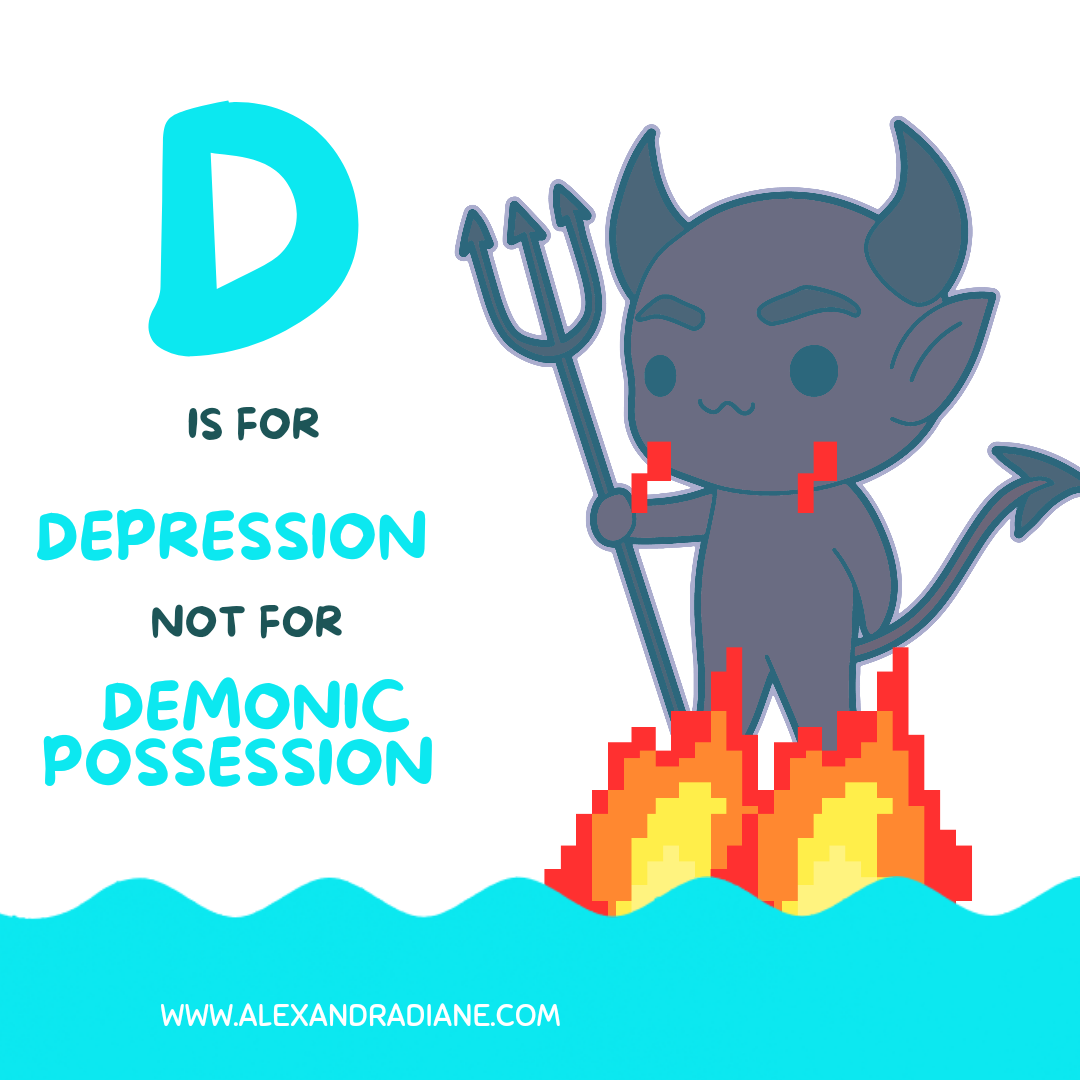
D is for Depression not Demonic possession

Please excuse any errors. I wrote this at 3am when I couldn’t sleep.

I find it easy to believe that people once believed depression or other mental illnesses were considered a demonic possession. I mean, do you really want to take responsibility for the thoughts of wanting to drown yourself and wonder if anyone would miss you? No, it must be the devil messing with your head. But I didn’t blame any evil forces for those thoughts. I sought professional help. I probably should have also sought spiritual help, but that’s for other issues entirely.


Since being on summer break, I’ve really had the chance to reflect on some of the differences in my postnatal life with Bennett compared to Adelyn. The first and biggest was being emitted back into the hospital the day after being released and told I would be separated from my newborn son. My logical side knew how dangerous my condition was, but that didn’t mean my emotional side could process what I was going through. Instead of trusting the healing process and getting better, I was bitter. I was alone in a place I detest and fear. To make matters worse, I was about to spend my 36th birthday alone. I have issues with my birthday. My cousin died on my birthday. I’ve had multiple years of people being flaky and disappointing me that I would leave the state so no one could make me feel less on an already horrible day. Physically I was recovering, while mentally, I felt myself breaking and falling apart the longer I stayed in bed with wires attached.

When I came home, I didn’t trust myself to be alone. I knew something was wrong. I loved my children and husband but felt like a shell of myself. There were a lot of moments that I know were faked. Holidays were taxing. Finances were tight. I was only bringing home 60% of my paycheck, and the extra insurance I’d been paying for the last three years just told me my coverage didn’t cover C-sections. Apparently, to them, they were an elected surgery, and they didn’t pay out the hospital stay like they would have if I had a vaginal birth. So that was 600 dollars I had budgeted that disappeared along with three years’ worth of payments.

Instead of thoroughly enjoying the time with my family, I was bombarded with emails and text messages from my students. The person left in charge was less than a glorified babysitter. He didn’t assign the detailed work I left, and the chaos students shared made me feel like I failed them. I know I couldn’t pick their sub, but good Lord, it weighed on me.

For nearly two months, I was at my doctor’s office battling an infection in my incision. Apparently, a small part of my body was reflecting the stitches. There was a laundry list of other things my body was doing, but I don’t fully remember them. I remember thinking everything was happening so fast and slow all at once. I remember, at three weeks, I was sitting in my doctor’s office telling her about how I needed something. Something to help me heal the wounds that no one could see. She said I couldn’t take anything while breastfeeding. I guess my body knew this before I did because my milk had dried up two days before the appointment.

I was nervous about taking a daily antidepressant. I didn’t want to lose myself. But the little voice of my logical self reminded me I was already lost. The shell I was presenting to the world wasn’t me. She ordered me Zoloft. I was warned about weight gain, and it possibly blocking my ability to climax, but I should feel like myself again. I had to fight with the crazy person inside my head, telling her that I could return to normal. Things would just have to change.

Slowly the unexplainable tears stopped. I was more in control of myself. However, instead of weight gain, I had to remind myself to eat. I was dropping weight fast and waiting to the point where I would get dizzy and nearly pass out. Being an appetite suppressant is not one of the side effects; however, I got it. When my cycle finally returned, my PMDD was under much better control. I was far less of a bitch those few days before my period. But I started noticing something strange.

A girlfriend, who used to be a nurse and was prescribed this drug, warned me about a side effect that the doctor didn’t address. Or maybe I didn’t think it would be an issue. I was starting to forget words. I’ve always had small moments when I forgot a word or two. However, while on this little happy pill, I forgot far more than a word or two. It was slowly progressing and becoming more difficult for me to explain things because it felt like a block between my mind and my mouth. A few weeks ago, it went fast passed word. There were moments in my day gone.

That was it for me. It didn’t matter how stable the medication was making me. What was the point if I had no memory? I no longer wanted to kill myself, and I had picked up my house that my depressed state destroyed. I felt better. So I stopped taking the pill of happiness. I was on the lowest dose, so there was nothing to ween off from.

For the last few weeks, things were good until the other day. Adelyn and I were talking, and she told me how her feelings were hurt by someone she thought was her friend. The friend said some really nasty stuff. It reminded me of the fake people I’ve encountered in myself. Only I was much older than her. I had to hold back tears because I hurt so much for her. I never wanted her to feel that way, especially at six years old.

The over feeling of sadness for others’ pain was something new and definitely not something I felt while taking the medication. I’m not sure how I would have felt on the pill. That mental state already feels like years ago.

I’ve also started to dream again. My dreams stopped after having my son. I guess being trapped in a hospital for a week was a living nightmare that my imagination didn’t think it could do better. While on the pill, I’d have dreams but not remember them. They would fade away as soon as I would wake up. Now I’ve returned to the moves that fill my head. Only they are disjointed and not yet useful for me. I wonder, once my brain is fully detoxed, what weird shit it’ll come up with.

But being off the happy pill has brought back my PMDD. I was not prepared for the emotions to be so strong. The rage is the worst. Everyone is doing something wrong by existing. I’m trying my best not to lash out. The kids do not deserve it. It’s not their fault their mother is unstable. I guess that’s why God gave me Bennett.

He’s the happiest little chunk. However, the only time he truly cries and gets upset is when others raise their voice or cry. Bennett is pure innocence. He’s a baby who only knows love, and when others are upset, he doesn’t understand why and will cry too.

I’ve had a few small outbursts that have brought him to tears. It has broken my heart, but it has also quickly changed my mindset. I can’t stay in the negative space because I have to comfort him. And it has to be me because he’s a pure momma’s boy, and Dad just isn’t good enough. Even though his first word was daddy… Which he said clear as day, yelling at Tyler.

So now I’m learning how to be me again without the outside chemical change. It’s uncomfortable, but I no longer feel like I’m fighting a demon whose main goal was to take me to the underworld. The only monster is me, and learning how not to release the angry red panda on my kids or husband. I’ll get through it. I’ve already survived once I know I’ll do it again.

Lent

Day 32: Reflecting on Biblical verses: Writing Prompts

I didn’t know what to write for today and was looking through different writing prompts for March. I couldn’t find the original chart that had the prompt about my classroom, so I kept searching. Everything that I was finding felt empty to me. It wasn’t until I found the prompt asking me to reflect on Matthew 6:14 – 15 did I feel compelled to write. This compilation was strange since I usually dislike reflecting on just one verse. Knowing the entire chapter the verse I was reflecting on came from was important to me because a verse on its own can be taken out of context. 

I will not pretend to be a biblical scholar who can recite scripture. I had to look this one up just like I had to do for the other two suggestions of Isaiah 53:9 and Ephesians 2:10–12. Matthew 6:14 – 15 in the NIV (the New International) bible says. “‘ 14 For if you forgive other people when they sin against you, your heavenly Father will also forgive you. 15 But if you do not forgive others their sins, your Father will not forgive your sins.”  I was curious how the NIV version differed from the Catholic Bible. “* If you forgive others their transgressions, your heavenly Father will forgive you. 15 But if you do not forgive others, neither will your Father forgive your transgressions.”

Not much of a difference, just an easier understanding for some readers of what a transgression may be. 

I think the reason Matthew 6:14-15 stood out to me over the verses from Isaiah and Ephesians has a lot to do with where I am in my life. The older I get, the harder it is to have the energy to hold grudges. I see no point in wasting my energy and time thinking about those who have negatively affected me in life. The perfect way to rub it in their face is that they have power over me, and my decision is to live the best life possible.

It was difficult to get to this point. There are plenty of ex-friends and boyfriends that I have wished ill on. If people would mention their names, I’m sure I’d spit just at the thought. However, I gained nothing from this besides a sour mood. It wasn’t until I got divorced from my first husband that I put this thought into action. If people would bring him up sometimes, I would discuss things, and other times I found myself saying, “I wish him nothing but to find happiness.” It was an odd way to think. My marriage had fallen apart, and I vocalized that my ex would find health and happiness. It was a much different way of thinking from wanting some of my ex-boyfriends to get run over by a truck. You would think that I would want the same for someone I thought I’d commit my life to. But how could I ever heal if I held onto hateful and negative thoughts? 

“14 For if you forgive other people when they sin against you, your heavenly Father will also forgive you. 15 But if you do not forgive others their sins, your Father will not forgive your sins.”

I remember the first time I went to confession and the lightness I felt after admitting my sins. Even though the sin was something I committed, I had never forgiven myself for what I had done. I held on to that pain for nearly a decade, and it did me no good. It just filled me with pain. 

After understanding how freeing it was to truly forgive myself, I never wanted to live with that toxic pain in my soul again. 

Until reading that verse today, I never gave it much thought. However, it makes sense and still makes sense for those who don’t believe in God. How can you let go of that animosity and pain if you never forgive the person who inflicted the pain upon you? You can’t because it will always linger in the back of your mind. 

Another reason this verse stood out to me over the one from Isaiah and the Ephesians had a lot to do with how digestible it was. I could read the verse and understand what it meant without reading the entire chapter.

The NKJV of Isaiah 53:9 reads, “And they made His grave with the wicked— But with the rich at His death, Because He had done no violence, Nor was any deceit in His mouth.” Since it was only the verse, I looked up the Catholic Bible chapter to see the differences and try to understand what was happening before and after the verse. “He was given a grave among the wicked, a burial place with evildoers, Though he had done no wrong, nor was deceit found in his mouth.” This verse varied more than Matthew’s did, depending on which bible you read it in. I also found the King James version harder to understand without reading the entire chapter. In my opinion, the verse from Isaiah is a lot harder to reflect on as a standalone verse. The book of Isaiah is from the old testament, and because of that, it has a Christian and Jewish interpretation. Isaiah was a prophet, and while Chapter 53 never identifies the suffering servant, many believe the chapter is prophesying Jesus. I am not really sure how anyone could just reflect on the verse without reading the entire chapter. 

I could have reflected on the other two verses from the new testament, just like Matthew.  Ephesians 2:10–12 from the NKJV reads, “For we are his workmanship, created in Christ Jesus unto good works, which God hath before ordained that we should walk in them. Wherefore remember, that ye being in time past Gentiles in the flesh, who are called Uncircumcision by that which is called the Circumcision in the flesh made by hands; that at that time ye were without Christ, being aliens from the commonwealth of Israel, and strangers from the covenants of promise, having no hope, and without God in the world.” VS Ephesians 2:10–12 from the Catholic Bible: “For we are his handiwork, created in Christ Jesus for the good works that God has prepared in advance, that we should live in them. Therefore, remember that at one time you, Gentiles in the flesh, called the uncircumcision by those called the circumcision, which is done in the flesh by human hands, were at that time without Christ, alienated from the community of Israel* and strangers to the covenants of promise, without hope and without God in the world.”

To me, the verses from Ephesians are lacking as standalone verses. You could read them and say, “yes, I understand the meaning of these words.” However, out of context, these verses are only a gentle reminder from Paul about our life before Christ. It doesn’t really stress the love of God and what the darkness was before salvation, which was the meaning of the chapter and the letter Paull had written. 

I guess I ended up reflecting on all three verses, though only truly relating one to my life. It’s not just the verses that I relate to but all of chapter six from the book of Matthew. It has always been one of my favorites, especially when we get around the time of lent. Matthew Chapter 6: 1 – 8 

1 “[But] take care not to perform righteous deeds in order that people may see them; otherwise, you will have no recompense from your heavenly Father. 

2 When you give alms, do not blow a trumpet before you, as the hypocrites* do in the synagogues and in the streets to win the praise of others. Amen, I say to you, they have received their reward. 

3 But when you give alms, do not let your left hand know what your right is doing,

 4 so that your almsgiving may be secret. And your Father who sees in secret will repay you. 

5 “When you pray, do not be like the hypocrites, who love to stand and pray in the synagogues and on street corners so that others may see them. Amen, I say to you, they have received their reward. 

6 But when you pray, go to your inner room, close the door, and pray to your Father in secret. And your Father who sees in secret will repay you. 

7 * In praying, do not babble like the pagans, who think that they will be heard because of their many words.* 

8 Do not be like them. Your Father knows what you need before you ask him.

After the verses, it leads into the lord’s prayer. 

While I share my faith here on my blog, I speak little about my faith in person. I don’t need to share it with everyone I meet. Everyone has their own relationship with God, and in south Florida, there are a lot of different churches with their take on Christianity. If the conversation comes up naturally, I will have no problem discussing my faith and how it has affected my life, but I will not scream it from the rooftops. I will not shove it down others’ throats because I don’t find it to be effective. I find living my life naturally and letting my actions show beliefs to be a lot louder than forcefully demanding those to listen to me and my journey in Christ. 

Lent

Day 2: Losing my religion to find my faith

Yesterday I found myself constantly picking up my phone and automatically going to where my social media apps used to live. I don’t like how addicted I am to mindlessly scrolling through the nonsense. It’s probably why I give up social media every year for Lent. I do kind of cheat since my website automatically sends out messages when I post a new blog, but I cannot see what people post in response. 

I think it’s ironic that I have ended up a Catholic who celebrates and follows Lent because I distinctly remember being a child sitting in church and getting upset about the idea of giving up something that I love. It’s taken years to process this memory. For the longest time, I could not remember why I was so upset during the service that morning, but now, as a convert, I do. The pastor had asked us to give up something we loved, and I remember being shocked. I did not understand his request. I thought he wanted me to give away my stuffed animals and toys, things I cherished, and I couldn’t understand why God would ask that of a child. I’m not sure if it was because we were a part of the Presbyterian church or that my mom didn’t explain the idea of Lent to us as children, but this moment set forth a journey in discovering my faith. I wanted to understand why I was being told to sacrifice what I loved. 

In elementary school, I went to Mass a few times with friends. Until that moment, I didn’t know there were different elements of faith. I had always thought there were Christians and Jewish people, those who believed in other Gods or nothing. But to understand that there were people who worshiped Christianity differently was a foreign idea. I thought we all were in the same boat. I remember coming home and asking my mom why the service I went to felt like an exercise, and she explained how some people worship differently and that if I had any more questions, I could ask my dad since he was Catholic. 

Finding out that my dad was Catholic surprised me because, in my young brain, I had rationalized him not joining us at church since he worked on Sundays. As I got older, this became more of a joke when my friends and I would discuss religion. A German Protestant and a non-practicing Irish Catholic raised me. This usually sparked fun conversations with my protestant friends, wondering how we celebrated things since they believed my dad wasn’t Christian. This would always confuse me because my dad was Christian. His faith just had a different name. 

In middle school, things got weird.

You know those pre-teenage years when kids are discovering themselves? Middle school was where I discovered the occult. The movie The Craft had just come out, and I think every girl who saw it thought they might actually be a witch. To make things even stranger, one day during gym class, we went out to the soccer fields, and scattered all over the grass were tiny tarot cards and burnt candles. I bent down and picked up a card, death. All my friends started whispering that I would die soon, and the rest of the school was stressful. When I got home, I logged online and tried to find out what the card meant. Let me tell you how relieved I was to find out that the death card didn’t mean I would die. In fact, it represented a major change in a person’s life. 

Not long after discovering the tarot cards in the field, my pastor gave a sermon about how people should avoid magic and the occult and never see a psychic or get a tarot card reading. It was strange and oddly timed to hear that message in church. He claimed he knew a person who had gone to get a psychic reading, and everything that the psychic said would happen happened. He claimed that no matter what the woman did; she was cursed and couldn’t prevent the events from happening. 

Around this time, my mom started looking for a different church. I don’t know if the two events were related, but I’d like to think my mom wouldn’t want us to be a part of a church that was going in that direction. 

At the end of eighth grade, we moved from our small Presbyterian church to a larger one where we knew no one in the congregation, and I felt lost. I grew up in our small church. I knew all the kids my age and was comfortable being around them. But moving to this bigger church, where we were just faces in the crowd, I was surprised to find a few kids I went to school with were a part of the youth service. I started to enjoy going to the youth service. The teens were excited to learn and were asking all sorts of questions. 

The summer between eighth grade and my freshman year of high school, I became fascinated with Queen Elizabeth the first and everything Tudor. The more I read about their family, the more I started understanding the divisions between the Protestant and Catholic faith. Learning that the Church of England was essentially created so a man could get divorced made me wonder what the driving points behind the Protestant faiths were. 

While walking through the halls of my high school, I ran into a friend I had swam with for the last five years. He noticed I was wearing a Celtic cross. 

“I thought you were Presbyterian?” he asked, pointing at my necklace. 

I looked down and said I am. 

He looked confused. “Then why are you wearing a Catholic cross?” 

“It’s not Catholic,” I told him, unsure if I was right. “It’s just Irish.”

This started a debate between us as we walked to class. We were both pretty steadfast that we were right in our own ways. It’s not like we could pull out a cell phone and check to see who was more right than the other. 

I forgot about the conversation until I went to church that Sunday. When I was about to ask the youth pastor about the cross, a discussion came up that I wasn’t prepared for. For some reason, the youth pastor started talking about those who are Catholic and Jewish and saying how we should be careful befriending them. Suddenly my question about the cross was no longer important, and I was listening intently why this person told me I shouldn’t be friends with people I had been friends with my entire life. I let him speak, and then I raised my hand. When he called on me, I asked him isn’t that the opposite of what Christ asks us to do? I asked him why he would tell us not to be friends with these people. And he said the reason was that the Catholics and the Jewish people would try to convert us away from our faith. I felt my face go hot. None of my friends or their parents have ever tried to convert me to their faith. But I had heard this man suggest multiple times that we should bring our friends in, try to bring them into our group, and have them see the way to Jesus. I asked him what was wrong with learning about other people’s religions. He responded we don’t want to be driven away from God. I sat on it for a moment and finally said if your faith in Christ is so weak that a conversation can make you convert to another religion; you didn’t have a strong enough faith to begin with. This started an issue with some kids in the youth service. They also started questioning what he was saying. Anecdote after anecdote came from the teenagers about how they were friends with Jewish, Catholic, and Muslim people, and nobody had ever asked them to join their faith. At the end of the youth service, the youth pastor pulled me aside and asked me if I would start such a commotion again and not return. 

After that, I stopped going to the youth services, and eventually, my mom stopped going on Sundays altogether. These two things had nothing to do with each other; they just happened to be around the same time. 

This man’s proclamation of not befriending people of different faiths only drove me to research more about religion. I wanted to know what the ground basis of the Presbyterian faith was. I wanted to see the difference between a Calvinist, a Protestant, and a Catholic and why this man was so afraid of what I could discover by talking to someone with a different belief. 

While my mother had given me the groundwork and the foundation for finding Christ in my life, it was ultimately up to me. I had to discover my relationship with my faith. 

As the internet became more of what we know it to be now, religion became easier to research. I saved bookmarks and tabs for me to go back and forth on. I tracked how Christianity became what we know it to be. 

By the time I graduated high school, I could no longer call myself a Presbyterian. I considered myself to be more agnostic. I was searching past the Judeo-Christian faith and looking at everything offered in our world. I was searching for something that felt like home. I wanted something to speak to my soul, and as of right now, nothing did.

When I went to college, I got extremely excited. They offered so many classes on religion in the secular sense that I nearly got a second degree in religious studies. I filled all my electives with courses that broke down religion in an easily digestible way. It made me more comfortable actually researching my faith on the secular and theological levels. But I also learned while taking these classes is how little people actually know about the core value of their faith. 

Something that I kept coming across as an adult that I came across as a child was people believed that Catholics were not Christians. I remember sitting in one class, and a woman said well, I’m a Christian, unlike these other people over here, and she pointed to a woman who had already shared that she was a Catholic, and the teacher laughed. At the beginning of the course, Christianity until the Reformation. This woman, who was a Baptist, did not know that Catholics believed in Jesus Christ. 

The deeper I dove into the meaning behind each religion, the closer I felt to the Catholic faith. I found comfort in the rituals and traditions. I looked closely at the Lutheran faith, the watered-down Catholics, and decided if I was going to convert, I was going all in. 

So years after college and before my first marriage, I decided to convert. My ex wanted to get married in the church, and I thought, what better time than now to prove I was committed fully to discovering my spiritual self? 

I found comfort in my Rcia classes, surrounded by other adults on the same path. Some were cradle Catholics who never fully understood the faith they grew up in, and others were converting like I was. Sometimes my knowledge from the secular side would cross over into lessons being taught. It felt like I almost had one up or insider’s knowledge. But I never expected the honesty of the father leading the classes. 

He spoke about how there were years when he lost faith. He told us about how he struggled with his spiritual journey and regretted how he was teaching catholic school and some of the smart-ass answers he would give the students. But as he found his way back to God, he would meet with those of other faiths. He would pray with them and discuss theology. One thing he said he was most jealous of was how Protestants prayed. It wasn’t formal like how the Catholics prayed, but more of a personal conversation. 

I had never looked at it the way. I had thought everyone prayed as if they were talking to God. Even though I was learning the different prayers used during mass, I figured it became more informal when people prayed outside of the church. After listening to the father talk, it appeared I was under the wrong assumption. 

As we grew closer to my conversion, I was required to go to confession. As a Presbyterian, I prayed to God, and He forgave me. I didn’t fully understand why I had to go into a room and talk to a human about my sins. But since I converted, I was going to do it entirely, and that meant getting over what made me uncomfortable and going all in. 

What I confessed was between God, the priest, and me. But I can tell you that this sin I cried was one that no matter how much I prayed, I never felt God’s forgiveness. It wasn’t until I went into that room and confessed what I did, did the weight finally leave my soul. Confession was almost like a mini therapy session. I have little to go off of, but the priest at my church has this way of making you feel welcomed, and when you are at your lowest, baring your soul, they make you feel loved and not judged or damned but understood why you deserve God’s forgiveness. 

At that moment, I knew my journey was over, and I was home. 

There are many times that I wish I could go back to that warm feeling. After my ex and I divorced, I returned to my church and picked up an annulment package. I felt such guilt for my marriage failing. It took me a while to feel comfortable sitting in a pew again. What made matters worse is I lost the package and never had the courage to get another one. 

A few years later, I brought my stepson to church. It was after a day where he was being super sassy, and I jokingly told him, “boy, you need Jesus in your life.” He looked confused, so I asked him if he had ever been to church. He said, “No. What is church?” But couldn’t pronounce the word church correctly. 

So I asked my husband if he minded if I took our son to church. He said no, he didn’t, but not to expect him to go. I didn’t. I knew my husband was an atheist, and I figured his ex wouldn’t mind since she was also Catholic. 

Sundays turned into a day of worship again. First, bring my young stepson and eventually my daughter. They did great in church, following along with the prayers and hymns. Parents and grandparents of other children would stop and tell me how much they enjoyed watching my kids worship. 

We went to Mass pretty regularly until COVID hit, and then we stopped. I remember going to ash Wednesday, and then the world shut down. 

I’m sad to admit it, but I didn’t want to go into the church if I had to wear a mask. The joy was gone, as I felt restricted. I would watch services being live-streamed, but it wasn’t the same. As restrictions were lifted, it took a long time before I stepped foot into my church again. 

However, just because I wasn’t spending Sunday mornings on my knees in worship didn’t mean my faith wavered. If anything, during that time, I dove deeper into my self-discovery again. I found myself praying more and talking to God, asking for guidance and signs along the way. 

When I finally did return to church, it felt as if I had gone away to college and come home. Things were the same, but some stuff had changed. I looked around as I walked through the double doors and sat on the far right side of the church. Some people masked others not, but one thing was the same: Everyone was there to worship how they felt comfortable. No one was passing judgment; if they did, they kept it to themselves. 

Ash Wednesday just passed, and I went to church for the first time in almost a year. I want to say I’ll go more frequently, but I don’t want to make false promises. I want my children to grow up with faith, but I don’t want to force them to believe as I do. I want them to have the tools to use as they are growing up to make the same choices I did. That way, they know their journey with God is genuine because that is the only way to have a strong relationship with faith.