Teaching, Writing

Finding Creativity After Postpartum Depression: Teaching, Burnout, Healing, and the Return of a Lost Spark

Today I made a newsletter for my students. While that may seem like a normal thing a teacher would do, it hasn’t been for me. For the last three years, I have been fighting to clear my head of the head fog left from postpartum depression. I knew something was wrong with me, but it wasn’t until December that I realized I was going through the motions and being a shell of my former self. 

The year prior, I stopped taking the antidepressants. They were leaving me numb to the world. I didn’t want to hold and cuddle my baby; I sought no joy in life. All the things they were supposed to fix, they didn’t. What they did was add on weight and affect my ability to feel. The only thing they stopped me from was killing myself. Now I wanted to die because the world was gray and I had lost the spark, even the spark to take my life. To most, it would seem crazy to stop taking the pills that were “keeping me alive”. However, this was not how I wanted to live.

For the next year, I would go through the most challenging time of my life. I wish I could go back and apologize to my children and husband. My emotions and nerves were kindling waiting for a match to strike, and most of the time I came home from work a bonfire lit by my students. I would lash out at anyone who stepped wrong. Not because they did anything so outlandish that it deserved my ire, but I was so over-stimulated from keeping myself under control at work that I exploded at home. 

Over the summer, I promised myself things would change. I wouldn’t allow my students to get under my skin. But I failed. I failed so miserably. After a horrible interaction with a parent who screamed in my face during open house, my classroom became a place of nightmares. Everything was grating on me. Students who usually listened, weren’t. Senioritis cursed the students I trusted to execute projects at a higher skilled level to underperform. But the blatant disrespect broke me at my core. 

It had me questioning every bit of my soul. Any other job, I would have left to find something that would bring me peace. But I didn’t want to abandon these kids. Kids who mostly didn’t give a shit until tears were streaming down my face. Some of those who brought on that response were too self absorb to understand they’d fucked up. I looked for other jobs. I went to several interviews, but none could match the salary I needed to earn to send my kids to camp when I no longer had summers off. Eventually I walked into my classroom with a fuck mentality. If the kids learned, awesome. If they didn’t, oh well. I understand that was a terrible way to think, but I had to stop being a doormat. 

Oddly enough, once I did that, the students changed. 

It was like being surrounded by a room of narcissists. Once they lost power, they had to find new ways to get attention. Their negative tactics weren’t working anymore, so they had to earn praise to earn my attention. And by the grace of God, my students started doing their work. It’s weird to sit and watch students work silently when for months you had been asking them to just lock in and do the work. 

The tension I carried with me started to fade. Enough so, I started to feel creative. For the last six months, I have been revising an old manuscript that may never see the light of day. It holds too many emotions that whenever I work on it I am taken back to dark places. I wanted to work on something new and fresh, so I partook in the 50k novel writing challenge that takes place in November. A spark had been lit, and I could write book two of Ravenmaster. For years I had been playing and doing research but never felt clear headed enough to write. By the time we reached Thanksgiving break, I had typed just under 24 thousand words. With everything going smoothly, I thought I could reach 50 thousand words and start revising over the Christmas break.

But life isn’t a Hallmark movie, like I was teaching in class. Or maybe it is because I am facing the possibility of cancer before forty. 

The 18 school days of December flew by, marked with appointments and biopsies that just led to more doctors. While I was in class, I looked at these groups of teens and was jealous. They had so much time to dream and learn, and I didn’t. Or maybe I did. I picked up a freelance job and edited a few podcasts. Nothing exciting, but it felt good to use my talents again. 

Between writing something fresh and original and editing, I felt alive again. The spark of creativity that died when I got pregnant with my youngest son was back. It was a feeling I had been chasing for years. There had been moments where I thought the veil had been lifted, but I think my toes were just skimming the bottom of the pool, allowing me to take a break from threading water. 

It wasn’t until I had two weeks off with my family did I finally see the light. Only this time it wasn’t a tunnel trying to kill me. My soul felt free. We spent our days carefree. I didn’t answer emails or texts from students. Some nights I wrote, other things I cuddled my babies. My husband and I took a trip with the older two and lived with no pressure. We emptied my bedroom and my husband laid new flooring. As we put things back I purged what I didn’t need anymore and I let feelings go along with it. 

I came back to school for the first time in three years excited. I had ideas about what I wanted to do differently. My inbox was filled with emails from industry professionals about the film world. I love reading them and now I know how to share them with the students. I’m going to kill myself and fight tooth and nail for them to preform. They aren’t a trick pony. But I will lead them with crumbs. Social media posts about topics I want them to learn. A newsletter beautifully designed with information that they’ll need once they leave this campus. All of it feels fresh. 

 I woke up on the new year feeling as if I could breathe for the first time. I always laugh because authors write about characters letting go of a breath they didn’t know they were holding. I think I understand what it means now. It may not be an actual breath but an emotion or fear that was keeping them down is now gone. 

Teaching, Writing

Support House Bill 1149: Essential Recess for Middle Schoolers

Usually, I want the government to stay out of education, but House Bill 1149 is something I could get behind, extending mandatory recess up to eighth grade! Absolutely! Yes, please do! That is if the bill isn’t pork rolled with extra nonsense. As of writing this, the bill currently does not have any unrelated funding or provisions, so I see no reason it shouldn’t pass. And it is so important for developing brains to have free play. 

I started my teaching career in middle school. Those three years were a nightmare wrapped in an amazing experience. However, I noticed these kids are overworked more than millennials and older generations were. The schools test students at an insane rate. Most of these kids are taking high school level math classes in 6th grade. Some students have six classes, and extracurriculars, sports, and Florida Virtual School (FLVS) classes so they don’t have to take certain ones in high school. Students in seventh grade were also remotely completing eighth grade simultaneously. These kids need a break. Their parents, teachers, and the school board are pushing them to a breaking point. We forget that middle school students are still children. They are not borderline young adults like those in their junior and senior years of high school. 

The first post I saw about this was littered with comments. So many people were saying isn’t this what P.E. is for? No, no, it’s not. P.E. is a class where students are still in a structured learning environment. It may be an athletic class, but there are still requirements that students must follow. And after seeing the comments, it’s obvious that the general public is blissfully unaware that most middle school students do not have P.E. at all. Many students who would be in a P.E. class are in intensive reading or other classes instead to help boost their grades and standardized test scores. 

Another argument from those who have never taught or haven’t been in a school setting in  recent years brought up lunch. They argued that this was a time for students to be social. However, with so many students in the public school system, most barely get through the line and have enough time to eat. And each school has a different way of handling lunch. Some schools allow students to sit wherever they would like in the cafeteria, while others will allow students to go outside or to the media center. But there are still some schools that require students to sit with their class. This leaves little time for students to decompress and be social because of the restrictions put in place.

One of the dumbest arguments people had for not implementing recess for middle students was that they would be on their phones. My answer to that is so what?! I am 99% certain that the adults complaining about kids escaping into their phones during breaks would do the same thing. People think playground when they think of recess. But recess is a time when children may do whatever they want. They can read, draw, talk to friends without worrying about being told they are too loud, or they can watch stupid videos on their phone and just be. It shouldn’t matter what they are doing with their time as long as they are outside and not being jerks to one another. Recess would be the only time in their day where they aren’t being told what to do. 

Many adults take this for granted. We go to work, but before and after work we are in control of our own lives, whatever that may look like. Children do not. If the students are in clubs or sports they are still being told what to do by adults. Yes, they may enjoy what they are doing, but it isn’t freedom of choice. When they get home, children also have their own responsibilities, be it chores or homework. But recess, this twenty minutes of supervised, unstructured free play is solely for being social. After students go home, it’s harder for students to see their friends. Some might live far away or have limited screen time with their phones or computers. But during recess, they are free to communicate with their friends in a way no classroom, including P.E. and lunch, will allow them. 

House Bill 1149 plans to allow a minimum of 20 consecutive minutes per day. Honestly, I am not sure how they would implement that. Most schools have their days structured with six 50-minute classes. It wouldn’t be wise to go any shorter than that. The schools could return to block scheduling, where classes are longer, allowing time for recess to be added to the schedule. Thankfully, this decision is above my pay grade. 

After I read this bill, I discussed with my freshmen how they would have felt having recess in middle school, and every single one of them said yes. Most claimed that they felt more burnout in middle school than they do in high school. At some of the middle schools in our area, they would have Fun Wednesday or Friday mornings with music and dancing in the courtyard. Sometimes they would have pep rallies at the end of the day. But they said if they had to pick from the two, it would have been a fun morning because they had a choice of where to go and what to do. However, if they could have had a midday break, that would have been better. Just time to stop and not feel the pressure of the day. Some said they would catch up on homework; one kid said he would take a nap, while others said they wanted to play basketball with friends who couldn’t have a PE class. One girl said she wanted to jam out with her band friends because they never have the chance to play the music they wanted. 

So to the adults making the decision in Tallahassee, please let’s do this. The kids need it. They want it. And what is so strange is that education keeps forgetting we’re here for the kids. We are here to make them better, and sometimes a break is what they need to do better and focus on who to be shaped into better students and, one day, members of society. 

Teaching, Writing

Writing with Passion: Overcoming AI Temptations

November has come and gone. I had high ambitions of meeting my goal of a 50k word count for Ravenmaster book two. Sadly, while I started off strong, I didn’t make my goal. As of today, the book two stands at 23,961 words with only three chapters in. I’m not disappointed in my progress. In fact, I am only 14,055 words short of my first book, and I plan on making this one longer. Many options try to tempt me to choose the easiest path. I could throw my ideas and planning documents into an A.I. site and ask it to write a 50k word novel, but it wouldn’t be my words. I wouldn’t have the passion that drove me to start this story in the first place.

Writing is hard work. It’s something I am trying to get my students to understand. For the last two months, I have tasked them with writing a nine page Hallmark script. It didn’t mean the script had to fall under the holiday umbrella; there is a lot more to Hallmark than Christmas. We spent a few days breaking down their bible and the formula the films follow. I thought it was amazing to have a guideline for them to follow. It gave their writing purpose and direction, a direction that was usually lacking in their writing. 

While Hallmark has its films broken down into nine acts, I have my students break theirs down into nine pages. That way, their film is only 9-10 minutes long. That alone is a task in itself.

The ideal story structure 10-Pages:

  • PG1- introduction/meet cute
  • PG2 – Inciting Incident
  • PG3- Early Bond/friendship
  • PG4- Midpoint/turning point
  • PG5 -Growth/conflict
  • PG6 Holiday event/Emotional Peak
  • PG7 Low Point//Doubt
  • PG8- Resolution/truth
  • PG9 Happy Ending/Celebration

My expectation was for every student to write their own story. I met with each and everyone of them. We discussed who their main character was, the setting, and the plot. I had them write their responses so no one could say, “I forgot what we talked about.” After talking with them all, I was hopeful. They seemed to get what was asked of them. 

After an ample time passed after the deadline, I started reading the scripts. I knew formatting issues were going to be a problem; that was to be expected. Sadly, I knew I would get frustrated by the lack of punctuation. For some reason, this generation thinks they are rude, while I just want to know when the sentence stops. But I had high hopes people would actually write their own stories. That isn’t the case. I’ve read twenty-six scripts, and I have another twenty-nine to go, and more often than not, I am coming face to face with A.I. work. 

The very first thing I do when I read my students’ work is open their Google Docs and check their version history. If it goes from 10:33 pm blank document, to 10:34 pm nine full pages, I am sad. They cheated. 

Some will cover it up and delete the markers that ChatGPT and other AI software leave within their writing. Some will even put the scripts in the proper format. While others are lazy and will straight up leave in space completing incorrectly and every single weird spacing, dash, and mark AI loves to use. 

I would rather correct the grammar, spelling, and story issues of someone who took the time out to write, rather than sigh at my screen. 

Some stories these kids prompt the robot to write are so cute, but they lack heart. The entire purpose of Hallmark. I want these young writers to craft dialogue. It forces them to explore different ways of talking and to take a closer look at how they interact with their peers and adults. When they write their own scripts, I get to see how they believe the adult world works. But all of that is lost when the robot generates the “perfect” script for the assignment. 

It’s weird because of this: when I read a really bad script, I get excited. It means the student tried. They put forth the effort and took a risk. Not only that, they gave me the time of day that I am giving them when I grade their work.

AI probably is going to kill writing for a while. It’s going to infiltrate our movies, books, and scientific work because it’s just easier. It’s easier to tell AI to write what you have in your mind and have the robot spit out ‌pages and pages of work. Unfortunately, people want the easy way out, and easy isn’t always better. 

I have 26,039 words left to write. I will do it. Somehow I will find time in my day to write them, just like I did when it came to writing the first 23,961 words. My goal is to make it longer than 50k, but it will take time. Time is meant for passion, and the written word should always be passionate. 

Teaching

Managing Classroom Anxiety: Protect Your Peace as a Teacher

Friday out right sucked. 

When my students came in, I had a full-blown panic attack. My anxiety took over, and I allowed my stress to control me. One of my students asked if I was okay, and the tears just started flowing. I asked her to grab our AICE coordinator to come watch my class because I knew there was no way that I was going to get myself under control until I removed myself in that situation.

 When she came in, a veteran teacher was with her. The coordinator sat with the class while the other teacher walked with me so I could just breathe. The coordinator was talking with the class, and one student said, “oh she’s just having a bad day.” The coordinator just looked at her and asked, “How can she just have a bad day when you guys are her first class?”

Living with anxiety is taxing. The last time I had a panic attack this bad was over a decade ago when I was living in Brazil. Loud noises surrounded me. I was in a dark space with people that I didn’t understand the language, and my ex-husband was getting blackout drunk. I felt so helpless in this situation that my brain just shut down because that was easier than dealing with how lost I felt. That night broke me so much that I knew my marriage was ending. 

Breaking in my classroom like that really made me wonder if I needed to end teaching and move on to a different career where I don’t invest my emotions that strongly into the workplace. 

When I broke in my classroom, it was because I was at a loss, but differently. The administration’s way of dealing with students on their phones or causing disruptions is to write them up, issuing a referral. I don’t want to do that because, for seniors, if they get any referral they are no longer allowed to participate in any of the fun activities. So instead of giving them a referral and stopping them from going to Grad Night or prom because they don’t want to stop talking while I’m trying to teach, I repeatedly asked them to stop doing whatever they’re supposed to not be doing. 

I broke because I’m trying to protect them from destroying their senior year within the first three weeks of school, but not a single one of them was thinking about what they were doing to me. And when it’s the students that you look forward to seeing most that end up being the ones on their worst behavior, it takes a toll on you. 

If I had been at home or out in public somewhere where I wasn’t worried about my job, I wouldn’t have had to swallow all of this negative energy. I could have screamed, yelled, or told them to just stop at a level that a mom does with their children that puts the fear of God into them. 

But I don’t want to be screaming at them. I don’t want to do that to my children at home and I don’t want to do this with kids, who are almost adults, that I’m trying to work with them at a professional level. A large majority of them have worked their butts off to earn that respect. 

But there are those who forgot that this is a classroom. They have forgotten that I’m a teacher and that they still need to learn. What is worse is that they forgot that their actions have full consequences. 

I’m no longer going to be protecting them. I need to protect my peace. And if writing them a referral is the only way to get them to understand that I am very serious about them learning and bettering themselves, then so be it. They don’t deserve to go on all these fun things if their behavior doesn’t earn it for them. I won’t allow myself to swallow all the negativity again. They not only affect me at the workplace, but they affect me at home. And the children that I have at home don’t deserve to get that backlash that I swallow for 8 hours every day. It should be those who are mistreating me that deserve that response. 

Teaching, Writing

Struggles of a Teacher: Managing Disappointment and Disrespect

How are you feeling right now?

I’m not.

Not good.

I’m disappointed.

I feel empty and betrayed. 

I came into this school year excited. I spent most of my summer planning out interesting ways to teach genres and trailer concepts to my students. I started with horror and built it from the start of the genre.But it seemed that, since I wasn’t dancing for TikTok or breaking up my lecture into two minute dopamine hits, a small amount tuned me out. Usually that is fine, but these students are loudest with their opinions. They are the ones who cause the most chaos. 

It sucks to have to fight with teenagers just to get them to stop talking. Hearing groan after groan makes my skin crawl. A few of these students switched into my class because they didn’t want to be in the other class. I don’t know what they expected from me. But it wasn’t to sit and listen to them bitch and moan. We are at school. You have to learn. Instead of watching trailers to watch the evolution of the genre and have all the pieces broken down, they could just read a textbook. I promise that would suck.

I started the week explaining how I stopped watching horror when I began working in news. There isn’t anything a filmmaker could create that is worse than what humans actually do. So on Thursday, the day after a monster shot up a Catholic school while children prayed at mass, I broke. 

I didn’t want to talk about death and destruction. 

I wanted to be distracted by what my students were planning to create. So as the juniors went off to their class meeting about rings, I spoke with my seniors about what the next two months looked like. Those who had me before were amazing. Scripts were already being planned out and teams built. But again there were a few who thought my class was a fuck around class. 

I hate it.

I will not be up the kids’ asses.

It doesn’t work for my class. 

My upperclassmen usually know that when I am giving them freedom, they are working one way or another. But some believe they must use their phones, shouting out things. I didn’t have the energy to fight yesterday. I just let those continue to make the same mistake over and over again. I hoped that I wasn’t going to have to collect phones from the almost adults, but it looks like I’ll be treating the majority like freshmen because the loud few can’t respect rules. 

I thought that was going to be the worst. Until a handful of my trusted kids broke my trust. I am not spelling out ‌what they did because it will be blatant who I am talking about. I have enough students who read my blogs and stalk my Instagram that they will know who I am talking about. But when people go back on their word and I find out, they are burned. There is not enough time in the school year for them to earn it back. They will graduate soon, and the years of trust that had been built has shattered. 

It sucks because I am here to listen to my students’ trauma dump all over me when they have problems. I help them with their classwork, look for jobs, scholarships, and things that are more than just teaching TV Production. If they had that elsewhere, they wouldn’t be asking me. I am not jaded in my belief that everyone has a stable home life or that they have an adult to seek guidance from. But because of that, I think they have forgotten I am the adult. I am not their peer. The disrespect has festered, and I am over it. 

So that is how I am feeling right now. 

I need a three day weekend to decompress without looking at a single email from parents accusing me of trying to fail their student because their child did not turn in work. 

Teaching, Writing

Confronting AI in Education: Teachers vs. Technology’s Role

Today was probably the most conflicting day I’ve had in a while. We finally had a PD set up for all the TV production teachers in the district to work together. We shared every level of equipment and what software people can use, and as a group we were successful. Teachers were asking questions, guiding others in how to use software in different ways. We didn’t just sit through the same training that most of us have experienced for years.

However, when we walked into the district mandated Khanmigo training, it took that feeling away. How are we supposed to feel as humans and as educators being forced and told time and time again to use artificial intelligence in place of our teaching? The replacement is a reading between the lines because the trainer said that Khanmigo was to be treated as an assistant and as our partner. Unfortunately, the entire presentation showed how human teachers could become null and void. 

Palm Beach County spent billions of dollars developing this artificial intelligence teacher assistant. Students are mandated to have at least 10 interactions with the artificial intelligence system a week or a month; I can’t really remember. But these interactions are supposed to hold a conversation with the robot. One teacher suggested we just have them log in and say hi to the AI. I shut down that idea quickly. I don’t have time to say, okay guys, don’t pay attention to me; ask the robot whatever you want. The amount of stuff my students have been flagged asking Khanmigo is absurd. Most usually ask about why some people in history killed themselves. Or how they can do horrible things to the robot. I would love to say here, ask the robot this question, but then the students will continue talking to the AI and ignore that class is starting. 

My real problem is that they don’t encourage us to have one-on-one conversations with our students. The county already is shoving down our throats this trusted adult system, but why are we not actually working on developing a strong bond with our students? Students are being encouraged ‌to ask questions and develop a relationship with the robot. It seems counterproductive. Maybe instead of our classrooms being heavily focused on tests, and earning money for the schools, we actually teach what we are trying to have the robots teach.

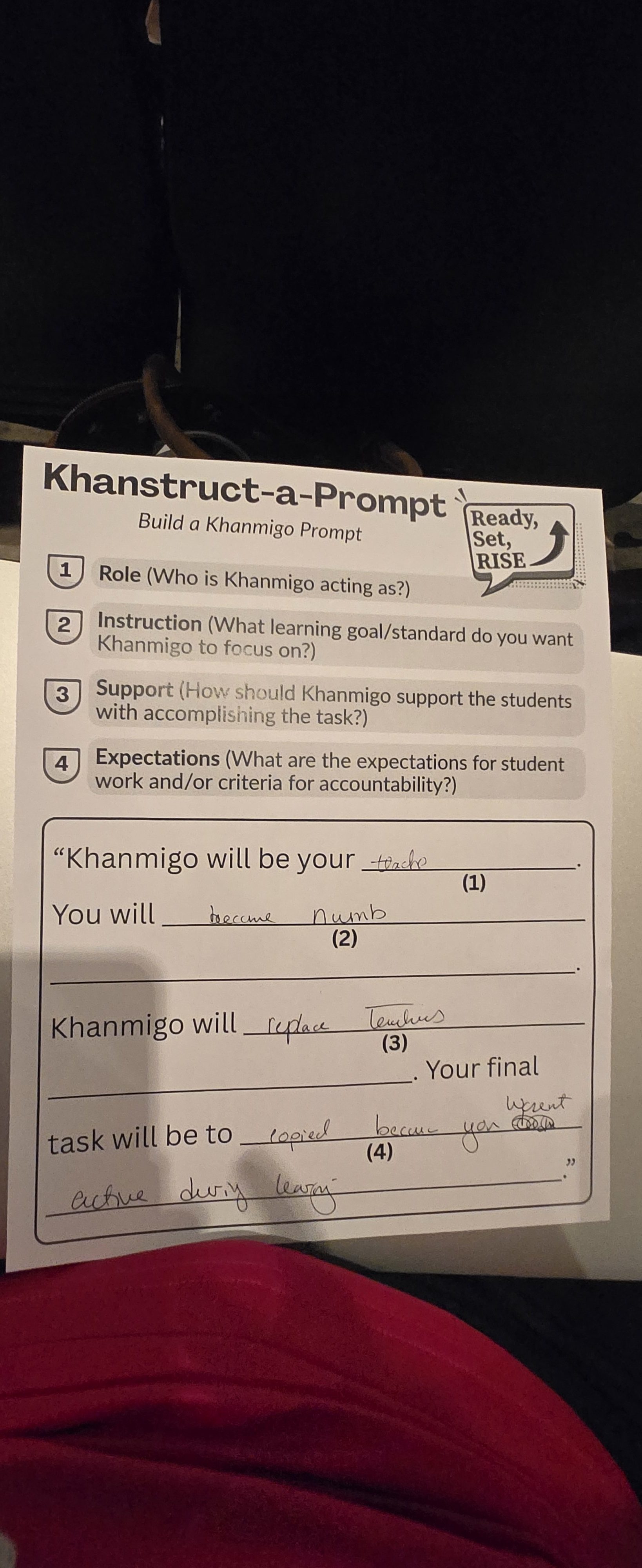
The session started with an example of a poorly written “Khanstruct-a-Prompt” about scriptwriting. It was truly degrading to read. But it was supposed to encourage teachers to develop one that would work better to engage with our students. And the next example did just that. The AI chooses a scene, does a scene breakdown, gives examples of how to write a script, elements needed in a script, and helps the students write their own scene. But all of this is passive. The student isn’t being engaged with. They aren’t checking in on what the student understands. 

At this point, I don’t have a job. That is what I teach my students at the beginning of their film class. I spent hours finding sources and examples for my students. Going over every way to write unique elements of a script. But it seems like it was all pointless if I tell the students, enter this prompt and talk to the robot. Mind you, I have done it with the robot; it gets stuck. It doesn’t understand the nuances of dialogue, and after a while, it keeps pushing out the same nonsense over and over again. 

After a few more examples, we filled out a paper and chose the role of AI. We filled in the instructions and standards the AI is to use, how it is to support the students, and the expectations of the students. But aren’t all of those elements what teachers are supposed to do? 

I am confused. I thought I was supposed to teach, not robots. Or is the district trying to figure out how to get rid of teachers outside of being glorified babysitters?

Now, this whole concept isn’t totally evil. Especially for teachers who don’t care about their job. I have heard plenty of students say they have teachers who don’t actually teach. I’ve had to help them learn how to research and write papers. If they have math questions, I just tell them I will pray for them and to go ask their teacher. They end up rolling their eyes and just googling the answer and never learning how to solve the problem.

But what about the teachers who actually teach? 

Are we supposed to stare at the back of the kids’ heads because we have prompted the AI to act like a teacher? That was a suggestion repeated multiple times in the session today. That we should prompt the AI to act like a teacher. The presenter kept referring to the Khanmigo as our assistant and encouraged us to talk with the AI to collaborate with it. 

I find it amusing that it’s named Khanmigo, aside from being a production of Khan Academy. The name Khan only brings two people to mind; Genghis Khan and Khan from Star Trek. Both are villains. I’m just trying to figure out what kind of villain this software is. Is it ruthless invaders or is it somebody with vengeance trying to destroy an entire race because they were wronged? 

Either way, I can see the forced implementation of AI in this way could destroy some teachers. Outsiders wonder why teachers are leaving the profession in droves. Once upon a time, the answer was rude kids or nasty parents. But now, more than not people don’t want to fight with the new mandatory “resource” that is to help “supplement” our lessons. 

Teaching

Navigating the Industry: A Teacher’s Perspective

In high school I remember smart mouth kids saying “If you can’t do, teach.”

 For some reason, they were taking digs at my English teacher that day. She was a young woman, twenty something and was still in her first three years of teaching. A woman who spent her college career with the goal of educating these smart mouth brats. I wish I could smack all of them. But thankfully, they were quiet during class. 

Now as I am teaching, How to Break into the Film Industry, I wonder how many students have that thought running through their mind. I know all the steps they need to follow. I know how hard the journey is they must take if they want to be successful. But why didn’t I do it?

First, no one showed me. 

I didn’t get an 85 page slide show presentation breaking everything down. The internet was in its infancy; the trades were only available in magazines and I didn’t even know that was a thing. Living in South Florida might as well have been another world compared to California. The internet was in its infancy and trying to navigate it to find websites and information was basically spy work. 

No wonder why millennials can search out a human who thinks they have no online footprint with ease.

  • But I digress. 

In that 85 page slide show I have links that direct students where to find casting class, production jobs, and locations to submit scripts. Those didn’t even exist really until a decade ago.

Secondly, I chose a school that was more about film theory than the physical creation of movies. That’s my fault 110%. FAU is ten minutes from the beach. I didn’t take college seriously. I just wanted to be done with my four years and I allowed other people to distract me. I worried about dating, partying, and traveling. I would never regret traveling the world. That is something I would still want to do. But partying and dating those were a waste of time. A waste of my location. 

Living in South Florida gave me an opportunity others didn’t have. I was close to the Miami Heat, Dolphins, Marlins, and the Panthers. Games were held nearly every day. I could have started doing grunt work and found my way into directing live sports events. At least I would have been on my path rather than waiting for an opportunity to come to me. It’s easy to look back twenty years later and think about how I should have sought them out while I was in school instead of heading to Ft. Lauderdale for other fun reason. 

Maybe that’s why I have put so much work into explaining to my students how to follow their dream. I need a big sign that says DON’T GET DISTRACTED.  

At one point, after a bunch of personal shit went down, I made it out to California. I met with kids going to Film school and talked to them. I learned they were in their third year and just starting film theory classes that I had already covered in my freshmen year. So there was a give and take. It’s also where I discovered I hated LA. It was like a far dirtier Miami. After a month meeting people with the same passion as I had, I learned I didn’t have the passion to sell my soul to the Gold Coast. I was east coast through and through. 

Being out there also taught me I loved writing; however, I enjoyed working in news. I missed the world of live theater and broadcast news blended my passions into one. 

I had to make the best of my degree: Communications and New Media. 

Filling my classes with subjects I was passionate about because I knew I wasn’t giving up my life to make movies. I wasn’t gypsy enough to worry about living job to job, moving my life around. If I wanted to do that, I would have joined the Air Force, and at least with that job, I wouldn’t have had to worry about a paycheck. 

With my students, I sit down with them, breaking down each college they are looking at, showing them what classes are offered. Do those classes meet their passion? Because recruiters talk a big game. They make their school look like the best no matter what. Thorough analysis into that is what it takes for a student to discover if the school is truly offering the subjects they want to learn.  

But what does this all have to do with the saying “If you can’t do, teach.” 

Well, I could do it. I did do it. And I learned I didn’t want to. Making films in school was more fun than 12 hour set days worried about if we went over budget and would get dropped. There was no fear of living paycheck to paycheck and hunting for the next job. And after working in broadcast for so many years, I was tired and ready for something fun. 

So maybe the saying is true for some teachers, but those ones don’t last. We can do it. We just don’t want to anymore. 

P.S. 30 days left of work until I get two months off…. Bliss! 

Teaching

The Impact of AI on Modern Education

How has technology changed your job?

Skynet, A.I., definitely not Skynet, the self-aware artificial intelligence network that perceives humans as a threat to its existence, thus starting a nuclear war and turning all robots against humanity. Even if a billionaire genius jokingly decided to name their AI Skynet, my students miss the foreshadowing of our impending doom, so long as they have weaseled their way out of homework. 

I have a love hate relationship with artificial intelligence. I grew up watching The Matrix, Space Odyssey, I Robot, and Terminator, none of which were a good thing for humanity. However, movies like Chappie and Wall-E pulled on my heart strings for those robots. And just like my mixed emotions about A.I. in the fictional world, I have the same for those in our world. 

At the start of the school year, teachers were told that we had to integrate Khanmigo into their daily use. As I sat in the factual meeting, I wondered who in the county was getting their palm greased by Khan Academy. It was dumbfounding how hard the district was pushing artificial intelligence to replace teachers’ lesson plans and student interaction. One of the biggest reasons they wanted teachers to use this program is they could track how often students were using it and what lessons were being used. I skirted this request because I wasn’t a core subject and the district had deemed us unimportant. The only lesson offered covered TV production, Pixar’s story structure, or something like that. But it wasn’t even directed for TV, it was meant to be used in English classes. 

Students have moved past using the limited Khanmigo and straight to ChatGPT or DeepSeek. I can’t fault them for asking for help from certain subjects. When they are doing math homework and are stuck on a problem, they ask ChatGPT to break down how to solve it. There is no difference from asking a teacher, who would be on their off hours when students are completing their homework. But the issue is most don’t just use the software when they are stuck. I have seen many who just input each problem and write the answer. Now we are back to the idea of students just regurgitating and no longer learning. In a single year, ChatGPT has single handedly circumvented years of teaching students weird multi-step processes of completing math work. 

While I have used ChatGPT to help me create lesson plans when I am stuck on how to create a new and fun, interesting way to present a subject, I have found my students doing the same for their script writing. I don’t fully hate the idea of them getting ideas, it would be the same as grabbing a card from Storymatic or prompts dice. I know not everyone is a storyteller and needs assistance. But it’s sad how quickly ChatGPT regurgitates the same storyline. My students don’t know this but I do, especially after reading four of the same script. Some students get creative and will put the script in proper format and change some character names, along with dialogue. But there are others who don’t. It’s just lazy. Part of their grade is writing in the correct format. If they just did that they would get more points. 

Outside of ChatGPT, adobe has integrated artificial intelligence into its software. Students have found it helpful creating voice overs when they have forgotten to record one and their projects are due. Others have used it to clean up their audio when they have poorly recorded their sound. Again, I don’t hate it. However, this is allowing them to be lazy. Instead of ensuring they have filmed everything they need for a project, they now shrug it off. That is the correct use of “I’ll fix it in post.” I need my students to follow their shot list. I also need them to learn how to film audio correctly. Because when they use the artificial intelligence to clean up their sound, it sounds off. Either the audio becomes thin or there is just an unnatural sound to it. 

Artificial Intelligence could be so helpful for students. It can guide them in ways that sometimes I can’t because it’s a room of 30 kids and I am just one person. However, I am finding that not to be the case. This is the generation that just uses technology without understanding how or why they use it, and AI is the same. Instead of sparking creativity and exploration, the kids are fine with allowing the machine to do all the work for them. So when Skynet, ChatGPT, finally takes over the world, my students will welcome their new overlord because the robots will do all the thinking for them. 

Lent, Writing

Teaching is a work of heart: How One Teacher Transformed My Professional Journey.

Who was your most influential teacher? Why?

This is the easiest answer. For the last twenty years, Earle Wright has quietly shaped the broadcast and production professional world. Our TV club’s Google Classroom claims we’re here for world domination, and with so many Wright grads in the workforce, it seems as if he’s succeeded in that mission.

Instead of writing something new, I’ll just share the letter of recommendation I wrote for my mentor and now colleague, Earle Wright.

I have had the privilege of knowing Earle since my time as a student at Dwyer High School from 2001 to 2005, where he first served as my TV production teacher. Throughout my career, Earle has been an invaluable mentor, shaping not only my career path into broadcasting but also inspiring my journey into teaching.

Earle has dedicated his career to shaping the future of broadcast journalism. Since joining Seminole Ridge High School in 2005, he has transformed the TV Production Academy into one of the most respected programs in the state. His commitment to excellence is unparalleled, and he holds all his students to a professional standard that often exceeds what I’ve encountered in my decade of professional experience. It’s not uncommon for his students’ work to rival that of college graduates, setting them apart in the competitive field of broadcast journalism.

I’ve seen firsthand the impact Wright’s teaching has had on countless students. When I worked at CBS 12, I knew that if a resume came across the News Director’s desk with “Seminole Ridge High School” on it, it would be moved to the top of the pile. The caliber of students coming from his program is unmatched, and it’s a reputation that has spread far beyond South Florida. Seminole Ridge alumni can be found in newsrooms and production studios across the country.

Wright’s influence extends far beyond his classroom. Even twenty years later, he continues to be my mentor, and I lean on his expertise and guidance to this day. Our partnership in mentoring future journalists and filmmakers has been mutually beneficial, helping me grow as a professional and educator. But his impact doesn’t stop there. Earle is the go-to person in the district for advice and support, always making himself available to help ensure that all schools in Palm Beach County have the resources they need to thrive. Whether it’s answering emails, phone calls, or texts, Wright’s dedication to helping educators and students in every corner of the district is unwavering.

While the FSPA State Teacher of the Year Award is dedicated to recognizing excellence in journalism education for one year, it is impossible to ignore the lasting impact Earle Wright has had on his students, colleagues, and the field of journalism as a whole. His contributions and mentorship go beyond a single year of recognition, and I firmly believe he deserves this honor for the profound, lasting difference he has made over the past two decades.

Teaching

PEBCAK

PEBCAK: Problem Exists Between Chair and Keyboard

I thought when I transferred from the newsroom to the classroom that I wouldn’t be playing tech support for my co-workers. My prediction was somewhat correct. I’m no longer tech support for my co-workers, however I am teaching basic computer skills far more than I ever expected to.

There is something terrifying about this generation. 

They were born with technology at their fingertips, yet none of them grasp how to use it. 

Today students were removing footage from their SD card. That isn’t something that I fault them not understanding, since every camera records footage in their own unique way. I was shocked to discover that not a single student could create a new folder or identify their desktop versus Google Chrome. A few didn’t even know how to right click with a basic mouse. Nearly every student told me that outside of a Chromebook, they did not use a computer. That was if they used a Chromebook, most simply used their phone or tablet. 

I thought the tech issues ‌were bad when I taught middle school. But those students, who are now sophomores, had stronger skills. These freshmen seem even more perplexed when using basic tech. 

It’s bizarre that most of these kids didn’t know how to click a mouse. When I tell them to right click on the mouse, they either double tap the left button or they just barely click the Right mouse button. And when we’re going back to regular clicking instead of clicking the left mouse button, they use the right one. Because all these kids have ever used is the trackpad or their finger on a phone or a tablet. 

It’s not just computing they have an issue with. Students keep confusing SD cards with SIM cards. They are not the same and despite my constant corrections; they don’t understand the difference between the cards. SIM cards allow mobile users to connect to phones to the network and it stores their user information. While an SD is a removable memory card. I’m sure you’re aware there’s a big difference between cellular connection and data storage. Apparently, the kids don’t think it’s a big deal.

I’m not sure when we stopped teaching kids how to type correctly, but I’m sure it’s around the same point when we stopped teaching cursive. We need kids to read cursive so they can read original documents and sign their name. At this point, I think we’re just going to have people marking X instead of signing their name like a pirate. 

That’s how I feel every time I’m asking these kids to type out a simple word and they’re hunting and pecking. Nobody knows what homeroom keys are. Nobody understands that if a word is already highlighted, they just have to type. They don’t need to press delete. They don’t need to do anything extra.

As I am teaching kids how to add new folders to their desktop, I am also teaching them how to copy files from their SD card and transfer it to their desktop. Watching kids figure out how to operate a mouse to highlight the files is entertaining and frustrating all at the same time. Teaching them shortcut keys like pressing control n to open a new file is mind-boggling to them. Pressing Ctrl a to highlight all the files that they need is magic. I don’t know how these kids have been using devices basically since kindergarten and nobody has actually explained to them what to do. 

We are doing these kids a disservice by not actually having basic computer classes anymore. I remember in elementary school where we would go to the computer lab and we would do typing drills and we would practice using our keyboards and did fun games. But in reality, these games were teaching us how to use the mouse correctly. These games that we would try to beat the leaderboards on were teaching us how to type correctly. It’s always funny to have my students watch me type a document as they’re talking to me and I’m not looking at my keys. It’s almost as if I’m an alien.

This is just a very bizarre world and I wonder how employers are dealing with the young adults entering the workforce. Are they sitting down with these fresh adults and showing them how to use a computer? Are these people asking questions or are they just staring at a desktop computer for the first time, hoping they can make it work? 

I could easily just say I teach TV production, not an intro to computer course, and leave it at that. But before I can have my students edit, I have to make sure they know how to operate a computer at the level that I was doing in elementary school. 

Thankfully, my students seem eager this year, but they aren’t ready to get into the nitty gritty. We’ve spent the last week putting cameras on tripods and learning how to use a professional camera. I hope when we open up Adobe Premiere Monday, things go smoothly. But I know I’ll be spending more time than I want teaching basic tech and how to operate a real computer.